

Industries · Space & Aerospace
High Emissivity Coatings in Space & Aerospace
NASA Ames origins·X-33 and X-34 programs·Space Technology Hall of Fame·aerospace components
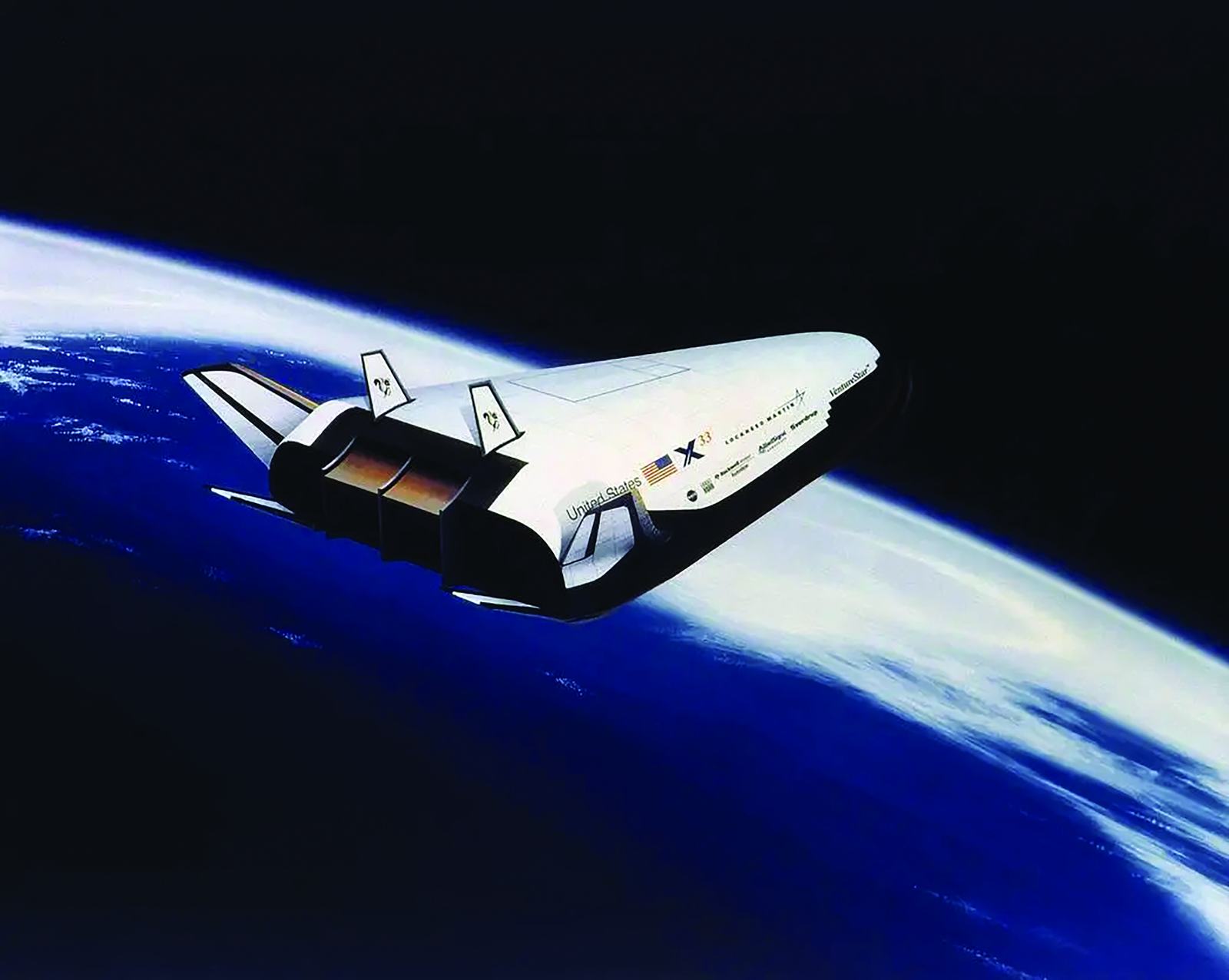
Before it coated industrial equipment, Emisshield's technology protected spacecraft. Developed at NASA's Ames Research Center in the early 1990s for thermal protection, including the X-33 and X-34 launch vehicle programs, the material was engineered to absorb intense radiant loads and re-emit them at extreme temperature. Emisshield licensed the technology in 2001 and has carried it into industry since, recognized by induction into the Space Technology Hall of Fame in 2021.
Where the Technology Comes From
- 2001
- Exclusive NASA license
- 2021
- Space Technology Hall of Fame
- -236 to 1,500°C
- Thermal shock in 3 seconds, no failure
- at least 10,000 PSI
- Adhesion
Atmospheric entry is the hardest thermal environment a material can face: radiant and convective heating beyond anything terrestrial industry produces, severe thermal shock, and zero tolerance for coating failure. NASA's Ames Research Center developed the high emissivity material to survive it, and the properties that resulted are the ones industrial customers buy today: emissivity of at least 0.96 (M-6) constant to 1,700°C, thermal shock from -236°C to 1,500°C in 3 seconds without failure, and adhesion of at least 10,000 PSI.
Re-entry and fired equipment are the same physics with the sign reversed. A spacecraft must shed radiant energy to survive; a heater, boiler, or kiln must capture it to save fuel. Both depend on a surface that holds high emissivity at extreme temperature. Emisshield licensed the technology exclusively in 2001, and the Space Foundation inducted it into the Space Technology Hall of Fame in 2021, with Dr. John Olver as the program's 85th individual inductee. That lineage is documented on the Quality & Certifications pages.
Emisshield continues to support aerospace and high-temperature component applications alongside its industrial business. For aerospace inquiries, contact the engineering team directly.

Aerospace and High-Temperature Component Applications
- 40+
- Industrial formulations from the space material
- 85th
- Individual inductee, Dr. John Olver
- Direct
- Aerospace inquiries to engineering
The same material, specified for components that see extreme radiant loads.
01Thermal protection heritage
X-33 and X-34 launch vehicle programs, NASA Ames Entry Systems and Technology Division.
02High-temperature aerospace components
Component coating for radiant and thermal-shock service; inquiries to Emisshield engineering.
03Industrial transfer
The industrial catalog: 40+ formulations serving ten industries. See Industries.
FAQ
Common Questions About the NASA Heritage
Is Emisshield really NASA technology?
Yes. Developed at NASA Ames and formally licensed to Emisshield, Inc. in 2001; the Space Technology Hall of Fame induction in 2021 is NASA-community recognition of that commercialization.
What were the X-33 and X-34?
NASA experimental launch-vehicle programs of the 1990s for which the thermal-protection coating chemistry was developed.
Can aerospace suppliers specify Emisshield today?
Yes. Contact us for aerospace component applications.
Next step
The Same Thermal Protection Now Serves Heat-Intensive Industries
See the industries, or send us the component and its service conditions.